 EN
 HR

Pocket Tools
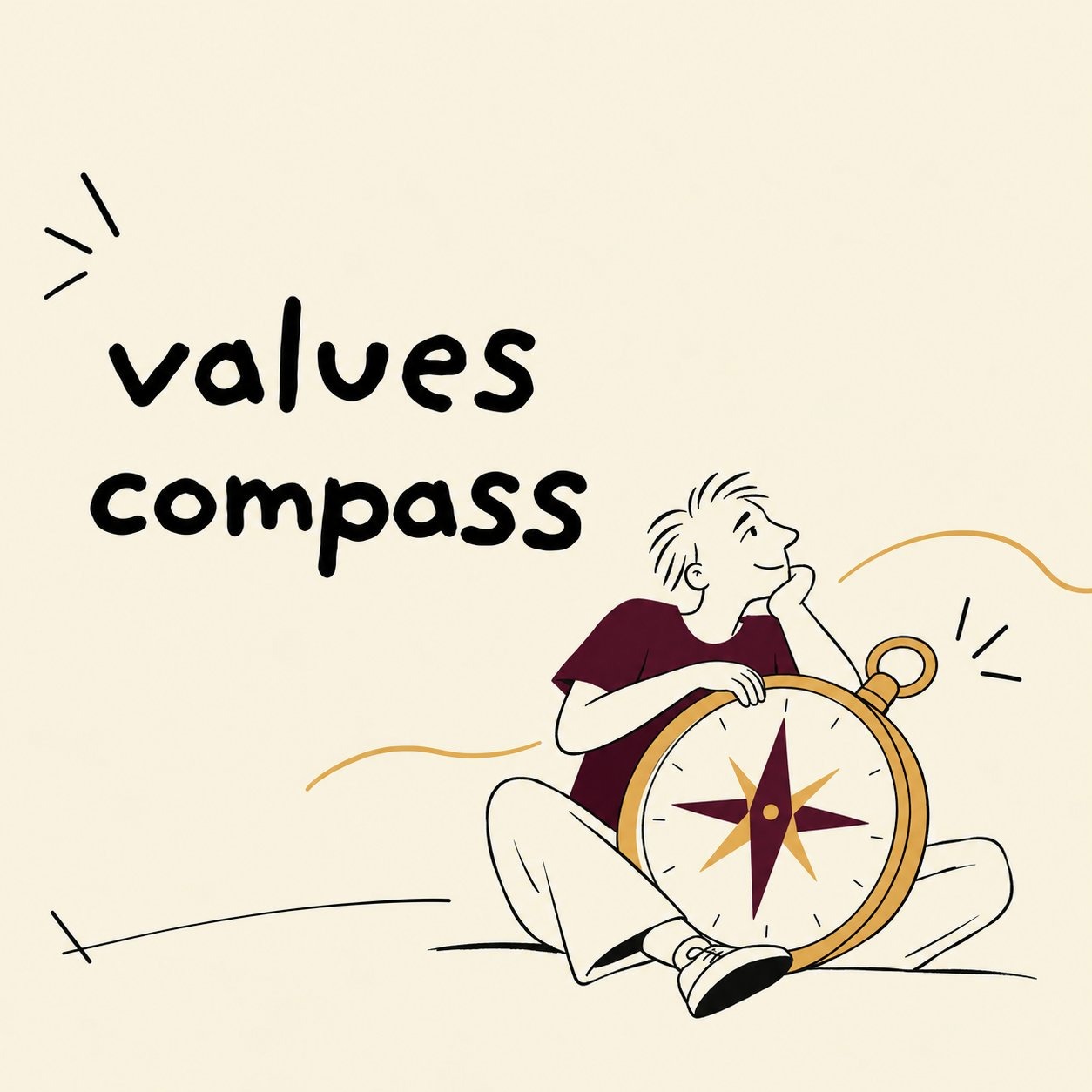
The Values Compass
What matters to you, and which way to walk
Learn what a value is and isn’t, sort a deck of forty, choose the few that are truly yours, take a kind look at how much room last week gave them, and pick one small step for this week.
What matters to you, really? Not what you think should matter, and not what matters most to the people around you, but what you’d want your life to keep heading toward. Psychologists call those things values, and the handful that matter most to you are often called your core values. Knowing yours won’t make the hard parts of life go away, but it gives you something to steer by when you don’t know which way to turn.
I’m bringing you one of my favorite techniques from ACT, aka acceptance and commitment therapy, and you can use it right here, on this page. The tool itself takes no longer than ten minutes the first time, and a couple of minutes when you come back. There’s no score at the end, and nobody is grading you!
Before you set out
Short on time? Start with the cards. The rest of the page is here whenever you want it.
Start sortingComing back? Go straight to part 4.
THE FIVE BEARINGS
01What a value is, and what it isn’t3 sections · 4 min
02Sort the deck1 section · 6 min
03Choose your few1 section · 4 min
04How much room last week gave your values2 sections · 5 min
Bearing 1 of 5
What a value is, and what it isn’t
A direction you keep walking in, and the four quarters it can point to
A direction, not a destination
Think of the difference between being a good friend and going to your friend’s birthday dinner on Saturday. You can go to the dinner, and then it’s done. You can’t finish being a good friend, because tomorrow there’s another chance to show up for them, and the day after that another one.
That’s what a value is: a direction you choose to keep walking in, never a place you arrive. In acceptance and commitment therapy, or ACT, values are the qualities you want your actions to have, meaning how you want to treat people, what you want to stand for, and who you want to be over time. They’re about what you do, not what you get.
That’s also why you can live a value on a terrible day. Honesty fits into one sentence. Kindness fits into a text message. Courage fits into the one phone call you’ve been putting off for a month. You don’t need to feel ready first, and you don’t need the rest of your life sorted out before you start.
Four things values get confused with
Values get mixed up with four other things, and each mix-up makes them a little harder to live by.
- A goal can be finished. Running a race is a goal, and caring for your body is the value it serves. When the race is over, the value is still there, pointing somewhere new.
- A rule comes with pressure. “I should call my mother every Sunday” is a rule. Staying close to her is the value, and on a busy week it might mean a voice message instead of a call.
- A feeling isn’t something you can choose. You can’t decide to feel confident, but you can choose to act with courage while you still feel unsure.
- Something you want from other people, like being admired or loved, depends on them and on luck. A value describes your part of it: treating people with respect, or being someone you can respect.
One quick question spots a goal: can you tick it off as done? Then it’s a goal, and it’s worth asking what it’s for. Part 3 has a second question, for telling a value that’s yours from a should.
The four quarters of the compass
Here’s something I find fascinating: all over the world, people’s values arrange themselves into the same shape.
The psychologist Shalom Schwartz and his colleagues asked people in more than 80 countries what mattered to them, and the answers kept falling into the same circle. Values that sit next to each other on it tend to get along. Values on opposite sides pull against each other.
Two tensions run across that circle. One is between caring for others and doing well for yourself. The other is between freedom and change on one side, and tradition, safety and belonging on the other. Those two lines split the circle into four quarters, and they’re the four quarters of this compass: caring and fairness, roots and belonging, freedom and discovery, and doing well and enjoying.
Because opposite quarters pull against each other, nobody lives every value fully at once. Time runs out, and a month spent chasing adventure leaves less of it for keeping traditions alive. Values work that way for everyone, and it matters later, when you look at the gap between what matters to you and what last week actually held.
The circle says something hopeful about people, too. Across countries, people agree about what matters more than they differ, and most of the differences sit between individuals rather than between nations. So there’s no right list for where you come from. Choosing duty to your family, your faith or keeping the peace is just as much a valued choice as choosing adventure or independence. Your list doesn’t have to look like anyone else’s!!
Tap a quarter of the compass to see the ten cards that sit in it, and the quarter it pulls against.
Bearing 2 of 5
Sort the deck
Forty cards, three piles, and no wrong answers
Now it’s your turn. Each card names a value and says what living it might look like, in the first person. Put each one in the pile that feels true for you today: matters a lot, matters some, or not for me right now.
Go with your first reaction. If you catch yourself wondering which pile you’re supposed to pick, that’s worth noticing, and go with the one that feels true rather than the one that sounds good. Nothing is locked in. When you’ve been through the deck, you can move any card to another pile.
The last pile is called “not for me right now” on purpose. A card that doesn’t speak to you today might next year. Putting it there isn’t a judgment of the value, or of anyone who holds it.
If something that matters to you is missing, write your own. You can add up to three.
Tap the pile each card belongs in. Back undoes the last card, and Skip moves a card to the end of the deck. Nothing you sort is saved or sent anywhere unless you choose to keep it on this device in part 5.
The deck
Missing a value? Write your own
Why the cards are worded the way they are
Every card is written as something you do, in the first person, because that’s the part you can choose. You might have expected cards like being loved, being attractive or having plenty of money. Those depend on other people and on luck, so the deck offers the value hiding inside each of them instead. Being loved became closeness, which is about sharing your inner world and making room for someone else’s. Having money became providing, which is about making sure the people who rely on you are secure.
See all forty cards, by quarter
All forty cards, by quarter
caring and fairness
- kindnessI treat people gently, and I count myself as one of those people.
- caringI look after people who need me, like a child, a parent getting older or a friend who’s ill.
- closenessI share my inner world with the people I love, and I listen when they share theirs.
- loyaltyI stand by my people when things get hard.
- honestyI tell the truth, and I think about how it will land.
- forgivenessI let go of grudges when I’m ready, including the ones I hold against myself.
- generosityI share what I have, whether that’s time, attention, food, money or skills.
- gratitudeI notice what others give me, and I say thank you.
- fairnessI play fair, and I speak up when something is unjust.
- care for the earthI look after the land, water and animals, in what I buy, use and throw away.
roots and belonging
- familyI make time and space for the people I call family, by birth or by choice.
- belongingI show up for the groups I’m part of, like a team, a neighborhood or a club.
- heritageI keep alive the language, customs and stories I come from.
- faithI live by my faith or spiritual practice, in whatever form it takes for me.
- respectI treat everyone with dignity, from my elders to people I disagree with.
- harmonyI keep the peace, and I think about how what I do affects the people around me.
- dutyI keep my promises and do my part, for my family, my community or my work.
- safetyI keep myself and the people close to me safe, and I build a life that feels steady.
- self-disciplineI do what I decided to do, even when I don’t feel like it.
- balanceI aim for enough, not too much, in work, spending and screen time.
freedom and discovery
- curiosityI ask questions and follow what interests me.
- learningI keep studying and picking up new skills, in a classroom or out of one.
- creativityI make things, ideas or solutions that weren’t there before.
- freedomI make my own choices about how I live and how I spend my time.
- being myselfI let people see the real me, even when it isn’t the popular thing.
- adventureI try new places, foods, people and experiences.
- courageI do the hard or frightening thing when it matters.
- aweI make time for things that make me feel small in a good way, like nature, music or the sky.
- meaningI spend my time on things that connect me to something bigger than myself.
- self-respectI take my own needs and limits seriously, and I’m willing to say no.
doing well and enjoying
- doing things wellI put real care and effort into my work or my craft.
- achievementI set myself challenges and see them through.
- growthI keep stretching, and I learn from what goes wrong.
- providingI earn and manage money well, so my household has what it needs.
- leadershipI step up and help a group find its way when that’s needed.
- good nameI live in a way that does my family and community proud, seen or unseen.
- healthI give my body the movement, sleep and food it needs.
- enjoymentI let myself enjoy the good things, like a long meal, a favorite song or a slow morning.
- playfulnessI play, I get silly, and I look for things to laugh about.
- being presentWhen I’m with someone or doing something, I try to really be there.
The cards are also written to work wherever you live, whatever you believe and whoever you love. Faith means any faith or spiritual practice, or the search for one. Family means the people you call family, by birth or by choice. Respect includes your elders, because for much of the world that’s where respect starts.
Bearing 3 of 5
Choose your few
Three to five values to steer by, and a gentle check that they’re yours
A compass with forty needles doesn’t point anywhere. From your “matters a lot” pile, choose the three to five that feel most like you right now. Those are your core values, the few you’ll steer by. If it’s hard to narrow down, imagine a friend describing you at your best, years from now. Which words would you most want them to use?
Three to five isn’t a rule from research. It’s enough to give you a direction, and few enough to keep in mind on a busy day, and you can choose fewer if fewer is true.
As you choose, each value takes its place on the compass, in its own quarter. If they all land in one quarter, that’s fine. It’s a picture of what matters to you now, and nothing needs evening out.
Tap three to five cards from your “matters a lot” pile. Tap a card again to put it back.
Your bearings
Is it yours, or is it a should?
Some values arrive from outside. A parent who always said work comes first, a workplace that treats being busy as a virtue, a feed full of people waking up at five. There’s nothing wrong with values you learned from other people, and many of the best ones come that way. The question is whether they’re yours now.
Researchers who study goals have found that the ones that fit a person’s own interests and values get steadier effort, are reached more often, and leave people feeling better when they get there. The same seems to go for values: ones held mainly to avoid guilt or disapproval tend to feel heavy, and they’re harder to keep going.
So for each of your picks, the compass asks one gentle question: would this still matter to you if no one ever knew? If the answer is “yes, it’s mine”, keep walking. If it’s “maybe it’s a should”, you can swap it for another card, or keep it and see how it sits with you over the next few weeks. Either is fine, and noticing it doesn’t mean you’ve done anything wrong.
Optional
Would this still matter to you if no one ever knew?
Prefer paper? The Values Compass also comes as a printable PDF, with a page to write down your own few values and all 40 value cards on the other.
Download the printable PDFBearing 4 of 5
How much room last week gave your values
A kind look at the distance, and what got in the way
Knowing your values is the start. What makes the difference is living them, and this is where it’s easy to get stuck, because looking at the gap between what matters to you and what you actually did can feel awful.
Here’s what the research says, and it’s kinder than you might expect. How important you rate a value says little about how you feel. Living it says more, and it works in both directions. When researchers followed people in Europe, India and Türkiye day by day, living some of their values lifted the next day, and a good day made it easier to live their values the next. Another study found the same thing from the other end: a low day tends to come before a day with less room for what matters. A hard week shrinks the room for everything, so a short needle tells you about the week, not about you.
That’s why this compass doesn’t ask how well you did. It asks how much room last week gave you, and there’s no score, no total and nothing marked in red.
One more thing is worth knowing. People who keep the closest eye on their valued actions, and find them the most effortful, tend to feel more distressed overall. In the moment, though, noticing a valued action goes with more meaning a few hours later. So noticing can help, as long as it doesn’t turn into keeping score. Look at your needles the way you’d look at a weather report: useful to know, and not a measure of your worth.
For each value, tap how much room last week gave you to live it: 0 is no room at all, and 4 is plenty. Its needle grows toward the edge of the compass. Then, if you like, choose what got in the way.
Last week
How much room did last week give you to live this?
What got in the way
One reason in that list deserves a closer look. If another value came first, nothing went wrong. Remember the quarters: opposite values pull against each other, and an evening spent sitting with a friend who’s struggling is an evening not spent on your own project. A short needle on one value can be the cost of living another. That’s a choice, not a failure!
Being kind about the gap
It’s tempting to turn your values into a stick to beat yourself with. I value my health, so why can’t I just get to the gym? I value my family, so what kind of person misses dinner three nights in a row? When that happens, values stop working as values and become one more way to feel not good enough.
Perfectionism goes with more distress, and a large analysis of students in the US, Canada and the UK found it has been rising for decades, so if your inner voice is harsh, you’re far from alone. Kindness here isn’t letting yourself off the hook. It’s what keeps you walking. If being kind to yourself feels hard, our article on self-compassion explains why it’s so difficult, and what helps.
Bearing 5 of 5
One small step, and coming back
Something small for this week, and why it’s worth returning
Big plans have a way of waiting for a better week. Small steps don’t. Pick one of your values and one thing you could do for it this week, small enough that you could manage it on a low day. It might be a message to a friend you miss, ten minutes outside before work, or saying no to one thing so there’s room for another.
Some therapies are built on exactly this. Behavioral activation for depression, for example, plans small activities that fit a person’s values, one week at a time.
Then give your step a when and a where. “If it’s Sunday after dinner, then I’ll call my brother” is more likely to happen than “I’ll call my brother more”. This kind of if-then plan has a lot of research behind it, and our article on if-then plans shows how to build one that holds up in a real week.
You can also tag your step with the part of life it belongs to, like family and home, or rest and play. Over a few weeks, the tags can make a pattern easier to spot.
Choose a value, write one small step, and, if you like, when you’ll do it and the part of life it belongs to.
Toward or away
Through the week you’ll meet small moments where you can take a step toward what matters to you, or a step away from it, often to escape a hard feeling for a while. It might be scrolling instead of calling, staying late instead of going home, or saying yes when you meant no.
Both kinds of step are human, and everyone takes both. The aim is to notice, more and more often, which way you’re facing, and to turn back when you can.
Coming back to it
Values are fairly steady, but they aren’t set in stone. The cards you’d choose after a move, a loss, a new baby or a new country might be different from the ones you chose today, and that’s healthy. It’s worth sorting the whole deck again after a big life change, or every few months.
Between those, come back once a week if you can, and rate how much room the week gave each value. It takes a minute or two. Over a few weeks you may start to see what tends to crowd your values out, and what makes room for them.
Below, you can keep your compass on this device, or copy it as text and keep it wherever you like.
Keep it, or copy it
There’s no finish line here, and that’s the point. A compass doesn’t tell you where you’ll end up. It tells you which way you’re facing, and whenever you lose your bearings, it’s still there to look at again.
A NOTE ON THE EVIDENCE
Well studied as a practice, not yet tested as a card sort
Working with values is one of the better-studied parts of acceptance and commitment therapy. ACT as a whole has been tested in many trials, summarized in twenty reviews, for anxiety, depression, chronic pain, substance use and more. It works better than no treatment or usual care, and about as well as cognitive behavioral therapy.
In laboratory studies, values exercises help people stay with discomfort, and exercises people actually do work better than explanations alone, which is why this compass is something you do rather than something you read. The World Health Organization’s self-help course for stress has a whole part on acting on your values, and it has been tested with refugees in Uganda, Türkiye and Western Europe. All three trials found real benefits, though in Western Europe they had faded by six months.
The card sort itself hasn’t been tested on its own, so there’s no good evidence yet about this exact tool. That isn’t evidence against it. Testing one small piece of a therapy is slow and expensive, and research hasn’t caught up with this format yet. Most values studies so far are also small, short and based on what people report about themselves. A 2026 review of 50 trials found that working on your values lifted mood, closeness and a sense of meaning more reliably than it eased anxiety or depression, and that it helped most when people went on to act on their values.
There’s also a well-known exercise in which people write for a few minutes about a value that matters to them. It has a small but reliable effect on health habits. Its effects on school results were much smaller in large repeat studies than in the first ones, and sometimes absent. So this compass doesn’t promise that naming your values changes anything by itself. Living them is the part that matters.
The compass is our own tool, built on other people’s ideas. Sorting values into piles comes from the Personal Values Card Sort, a public-domain tool used in motivational interviewing, a way of counseling that helps people find their own reasons to change. Rating how much you lived each value over the past week comes from the Valued Living Questionnaire. Looking at the distance from what matters comes from the Bull’s-Eye Values Survey, and keeping progress separate from what got in the way comes from the Valuing Questionnaire. Noticing small steps toward or away from what matters comes from the choice point, an idea from Russ Harris and colleagues.
The four quarters follow Shalom Schwartz’s theory of basic human values. Which quarter each card sits in is our own best fit, since his research sorted broad values, not these exact cards. The words, the cards and the drawing are all our own. This is a tool for reflection, and it isn’t therapy or a diagnosis.
IF EVERYTHING FEELS FAR AWAY
When nothing seems to matter
Sometimes the hard part isn’t choosing your values. It’s that nothing feels like it matters at all, every card looks gray, and the future feels empty. If that’s where you are, please don’t treat this as an exercise you’re failing. Feeling that way for weeks can be a sign of depression, and you deserve real support with it.
A doctor is often a good first step, partly because they can check whether something physical is involved. Not everyone can see one, and for some people it isn’t affordable or safe. A counselor at school, college or work, a community mental health service, a free helpline or chat service, or one person you trust can all be a way in.
If you’re having thoughts of ending your life, you don’t have to wait until it’s an emergency to talk to someone. You can find the crisis lines and emergency numbers for your country on our helplines page, and our article on suicidal thoughts explains what helps and how to start that conversation. If you might act on those thoughts, or you’re in danger right now, call your local emergency number.
REFERENCES
- Acarturk, C., Uygun, E., Ilkkursun, Z., Carswell, K., Tedeschi, F., Batu, M., Eskici, S., Kurt, G., Anttila, M., Au, T., Baumgartner, J., Churchill, R., Cuijpers, P., Becker, T., Koesters, M., Lantta, T., Nosè, M., Ostuzzi, G., Popa, M., . . . Barbui, C. (2022). Effectiveness of a WHO self-help psychological intervention for preventing mental disorders among Syrian refugees in Turkey: A randomized controlled trial. World Psychiatry, 21(1), 88-95.
- A-Tjak, J. G. L., Davis, M. L., Morina, N., Powers, M. B., Smits, J. A. J., & Emmelkamp, P. M. G. (2015). A meta-analysis of the efficacy of acceptance and commitment therapy for clinically relevant mental and physical health problems. Psychotherapy and Psychosomatics, 84(1), 30-36.
- Bardi, A., Lee, J. A., Hofmann-Towfigh, N., & Soutar, G. (2009). The structure of intraindividual value change. Journal of Personality and Social Psychology, 97(5), 913-929.
- Branstetter-Rost, A., Cushing, C., & Douleh, T. (2009). Personal values and pain tolerance: Does a values intervention add to acceptance? The Journal of Pain, 10(8), 887-892.
- Breines, J. G., & Chen, S. (2012). Self-compassion increases self-improvement motivation. Personality and Social Psychology Bulletin, 38(9), 1133-1143.
- Chase, J. A., Houmanfar, R., Hayes, S. C., Ward, T. A., Vilardaga, J. P., & Follette, V. (2013). Values are not just goals: Online ACT-based values training adds to goal setting in improving undergraduate college student performance. Journal of Contextual Behavioral Science, 2(3-4), 79-84.
- Ciarrochi, J., Bailey, A., & Harris, R. (2014). The weight escape: How to stop dieting and start living. Shambhala.
- Cohen, G. L., Garcia, J., Apfel, N., & Master, A. (2006). Reducing the racial achievement gap: A social-psychological intervention. Science, 313(5791), 1307-1310.
- Curran, T., & Hill, A. P. (2019). Perfectionism is increasing over time: A meta-analysis of birth cohort differences from 1989 to 2016. Psychological Bulletin, 145(4), 410-429.
- Epton, T., Harris, P. R., Kane, R., van Koningsbruggen, G. M., & Sheeran, P. (2015). The impact of self-affirmation on health-behavior change: A meta-analysis. Health Psychology, 34(3), 187-196.
- Fischer, R., & Schwartz, S. H. (2011). Whence differences in value priorities? Individual, cultural, or artifactual sources. Journal of Cross-Cultural Psychology, 42(7), 1127-1144.
- Gloster, A. T., Walder, N., Levin, M. E., Twohig, M. P., & Karekla, M. (2020). The empirical status of acceptance and commitment therapy: A review of meta-analyses. Journal of Contextual Behavioral Science, 18, 181-192.
- Gollwitzer, P. M., & Sheeran, P. (2006). Implementation intentions and goal achievement: A meta-analysis of effects and processes. In M. P. Zanna (Ed.), Advances in experimental social psychology (Vol. 38, pp. 69-119). Academic Press.
- Grégoire, S., Doucerain, M., Morin, L., & Finkelstein-Fox, L. (2021). The relationship between value-based actions, psychological distress and well-being: A multilevel diary study. Journal of Contextual Behavioral Science, 20, 79-88.
- Hanel, P. H. P., Tunç, H., Bhasin, D., Litzellachner, L. F., & Maio, G. R. (2024). Value fulfillment and well-being: Clarifying directions over time. Journal of Personality, 92(4), 1037-1049.
- Hanselman, P., Rozek, C. S., Grigg, J., & Borman, G. D. (2017). New evidence on self-affirmation effects and theorized sources of heterogeneity from large-scale replications. Journal of Educational Psychology, 109(3), 405-424.
- Hayes, S. C., Luoma, J. B., Bond, F. W., Masuda, A., & Lillis, J. (2006). Acceptance and commitment therapy: Model, processes and outcomes. Behaviour Research and Therapy, 44(1), 1-25.
- Hayes, S. C., Strosahl, K. D., & Wilson, K. G. (2012). Acceptance and commitment therapy: The process and practice of mindful change (2nd ed.). Guilford Press.
- Lejuez, C. W., Hopko, D. R., Acierno, R., Daughters, S. B., & Pagoto, S. L. (2011). Ten year revision of the Brief Behavioral Activation Treatment for Depression: Revised treatment manual. Behavior Modification, 35(2), 111-161.
- Levin, M. E., Hildebrandt, M. J., Lillis, J., & Hayes, S. C. (2012). The impact of treatment components suggested by the psychological flexibility model: A meta-analysis of laboratory-based component studies. Behavior Therapy, 43(4), 741-756.
- Limburg, K., Watson, H. J., Hagger, M. S., & Egan, S. J. (2017). The relationship between perfectionism and psychopathology: A meta-analysis. Journal of Clinical Psychology, 73(10), 1301-1326.
- Lundgren, T., Luoma, J. B., Dahl, J., Strosahl, K., & Melin, L. (2012). The Bull’s-Eye Values Survey: A psychometric evaluation. Cognitive and Behavioral Practice, 19(4), 518-526.
- Matheus Rahal, G., & Caserta Gon, M. C. (2020). A systematic review of values interventions in acceptance and commitment therapy. International Journal of Psychology & Psychological Therapy, 20(3), 355-372.
- Miller, W. R., C’de Baca, J., Matthews, D. B., & Wilbourne, P. L. (2001). Personal values card sort. University of New Mexico.
- Napier, A. D., & Mangat, A. (2026). The well-being and ill-being impacts of values clarification: A systematic review of randomised controlled trials. The Journal of Positive Psychology. Advance online publication.
- Protzko, J., & Aronson, J. (2016). Context moderates affirmation effects on the ethnic achievement gap. Social Psychological and Personality Science, 7(6), 500-507.
- Purgato, M., Carswell, K., Tedeschi, F., Acarturk, C., Anttila, M., Au, T., Bajbouj, M., Baumgartner, J., Biondi, M., Churchill, R., Cuijpers, P., Koesters, M., Gastaldon, C., Ilkkursun, Z., Lantta, T., Nosè, M., Ostuzzi, G., Papola, D., Popa, M., . . . Barbui, C. (2021). Effectiveness of Self-Help Plus in preventing mental disorders in refugees and asylum seekers in Western Europe: A multinational randomized controlled trial. Psychotherapy and Psychosomatics, 90(6), 403-414.
- Sagiv, L., & Schwartz, S. H. (2022). Personal values across cultures. Annual Review of Psychology, 73(1), 517-546.
- Sarrión, P., Cebolla, A., Santamaria-Rincon, M., Llinares-Monllor, C., Desdentado, L., & Baños, R. (2026). Advancing our understanding of valued living: An ecological momentary assessment of behavioral and experiential aspects of valued actions, well-being, and emotional distress. Applied Psychology: Health and Well-Being, 18(3), Article e70151.
- Schwartz, S. H. (1992). Universals in the content and structure of values: Theoretical advances and empirical tests in 20 countries. In M. P. Zanna (Ed.), Advances in experimental social psychology (Vol. 25, pp. 1-65). Academic Press.
- Schwartz, S. H. (2012). An overview of the Schwartz theory of basic values. Online Readings in Psychology and Culture, 2(1).
- Schwartz, S. H., & Bardi, A. (2001). Value hierarchies across cultures: Taking a similarities perspective. Journal of Cross-Cultural Psychology, 32(3), 268-290.
- Sheeran, P., Listrom, O., & Gollwitzer, P. M. (2025). The when and how of planning: Meta-analysis of the scope and components of implementation intentions in 642 tests. European Review of Social Psychology, 36(1), 162-194.
- Sheldon, K. M., & Elliot, A. J. (1999). Goal striving, need satisfaction, and longitudinal well-being: The self-concordance model. Journal of Personality and Social Psychology, 76(3), 482-497.
- Smith, B. M., Villatte, J. L., Ong, C. W., Butcher, G. M., Twohig, M. P., Levin, M. E., & Hayes, S. C. (2019). The influence of a personal values intervention on cold pressor-induced distress tolerance. Behavior Modification, 43(5), 688-710.
- Smout, M., Davies, M., Burns, N., & Christie, A. (2014). Development of the Valuing Questionnaire (VQ). Journal of Contextual Behavioral Science, 3(3), 164-172.
- Tol, W. A., Leku, M. R., Lakin, D. P., Carswell, K., Augustinavicius, J., Adaku, A., Au, T. M., Brown, F. L., Bryant, R. A., Garcia-Moreno, C., Musci, R. J., Ventevogel, P., White, R. G., & van Ommeren, M. (2020). Guided self-help to reduce psychological distress in South Sudanese female refugees in Uganda: A cluster randomised trial. The Lancet Global Health, 8(2), e254-e263.
- Wilson, K. G., & Murrell, A. R. (2004). Values work in acceptance and commitment therapy: Setting a course for behavioral treatment. In S. C. Hayes, V. M. Follette, & M. M. Linehan (Eds.), Mindfulness and acceptance: Expanding the cognitive-behavioral tradition (pp. 120-151). Guilford Press.
- Wilson, K. G., Sandoz, E. K., Kitchens, J., & Roberts, M. (2010). The Valued Living Questionnaire: Defining and measuring valued action within a behavioral framework. The Psychological Record, 60(2), 249-272.
- World Health Organization. (2020). Doing what matters in times of stress: An illustrated guide.
- World Health Organization. (2026, September 11). Depressive disorder (depression) [Fact sheet].
- Wu, Z., Spreckelsen, T. F., & Cohen, G. L. (2021). A meta-analysis of the effect of values affirmation on academic achievement. Journal of Social Issues, 77(3), 702-750.
BOOKS FROM OUR SHELF
Last reviewed October 2026

WORKING WITH THIS
When you know what matters, but can’t get there
Sometimes you know exactly what matters to you, and something keeps pulling you the other way: fear, exhaustion, old rules about who you’re supposed to be, or a life that leaves no room. Therapy is a place to look at what’s in the way, make room for the hard feelings that come with moving toward what matters, and plan steps that fit your actual week. If you already see one of us, the text you can copy in part 5 is a good thing to bring along.